You've saved the inspiration photos. You've imagined yourself with brighter, more dimensional hair. You're ready for a change.
There's just one question.
Do you book highlights or balayage?
If you've ever found yourself staring at a salon's service menu wondering what the difference actually is, you're certainly not alone.
Both techniques can create beautiful, dimensional color, but they achieve it in different ways. And depending on your hair goals, one may be a better fit than the other.
First, What Are Foil Highlights?
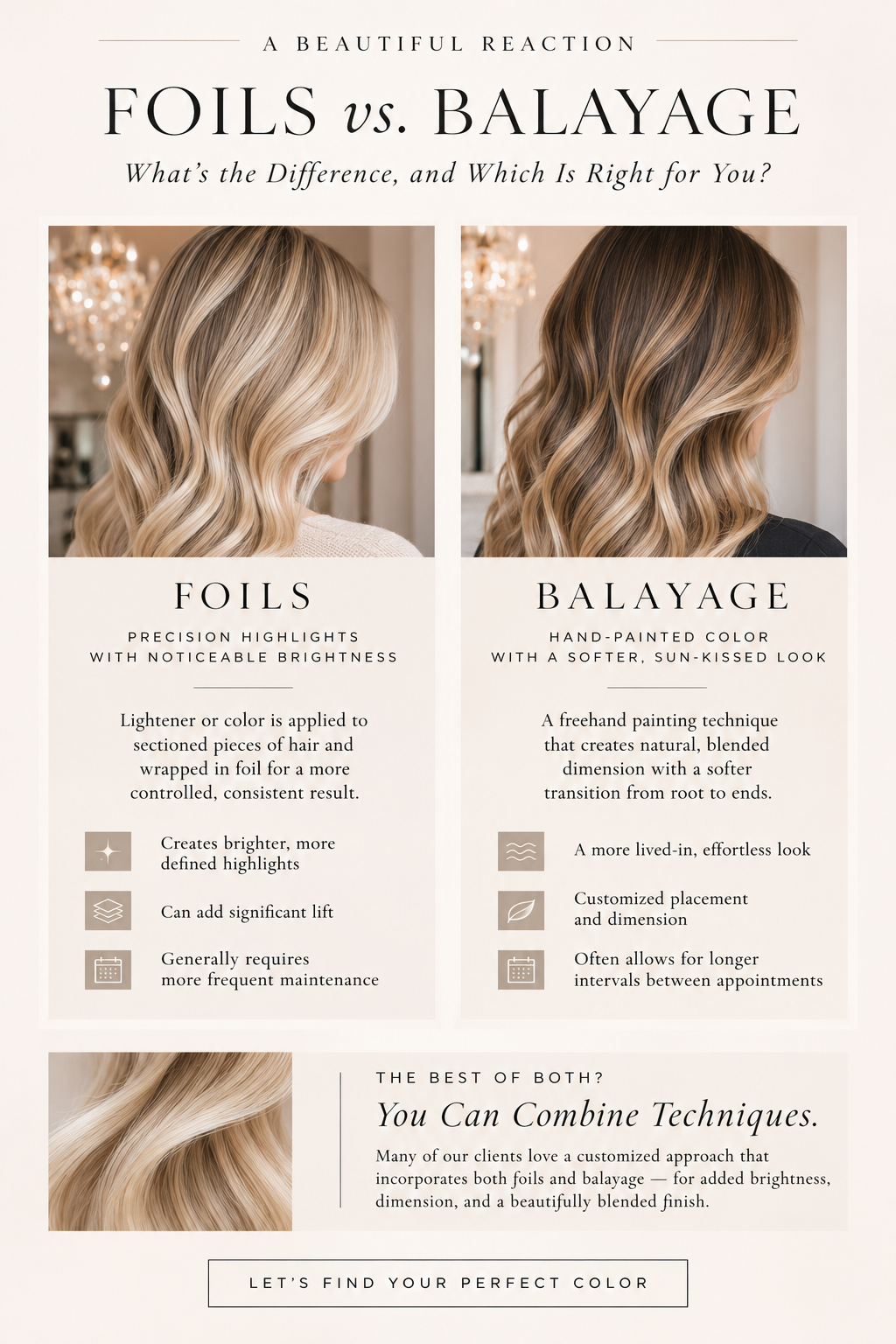
Foil highlights are created by sectioning pieces of hair, applying lightener or color, and enclosing those sections in foil.
This allows your stylist to work with precision, controlling the placement and intensity of the highlights.
Foils are particularly useful when you want noticeable brightness, a consistent highlighted look, or lighter pieces that extend closer to the roots.
They can also be helpful when achieving a significant amount of lift.
The overall look: Depending on placement, foil highlights can create anything from soft, delicate dimension to a bright, beautifully blended blonde.
And What Exactly Is Balayage?
Balayage comes from a French word meaning "to sweep."
Traditionally, it's a hand-painting technique in which your stylist applies lightener to selected sections of hair, creating a customized pattern of brightness.
The result often features softer transitions between your natural color and lighter pieces.
Think effortless, dimensional, and a little sun-kissed.
Because the color can be placed away from the scalp, balayage often allows for a softer-looking grow-out.
But here's something worth knowing: balayage isn't necessarily one specific finished look. It's a technique, and your stylist can customize it considerably.
Which One Requires Less Maintenance?
This is where things get interesting.
Traditional highlights placed close to the scalp generally create a more noticeable line of regrowth, so clients often return more frequently to maintain that freshly highlighted appearance.
Balayage with a softer root transition may allow for longer intervals between lightening appointments.
However, your maintenance schedule depends on your desired brightness, natural hair color, tone, and how polished you want your color to look.
Even low-maintenance blondes may need occasional toning or glossing appointments to maintain their preferred shade.
Can You Combine Foils and Balayage?
Absolutely!
Some of the most beautiful dimensional color comes from combining techniques.
You may hear the term foilayage, which generally describes balayage-inspired placement combined with foils to achieve additional lift.
Your stylist may also use traditional highlights around the face while creating softer, painted dimension through the rest of the hair.
The important thing isn't choosing a trendy name.
It's choosing the technique, or combination of techniques, that achieves your desired result.
So, Which Should You Choose?
Consider what you want your hair to look like between appointments.
Do you love a brighter blonde that starts close to your roots?
Do you prefer a softer, lived-in look?
Are you hoping for a dramatic transformation or subtle dimension?
And how often do you realistically want to visit the salon?
These are the questions worth discussing during your consultation.
At our Meridian, Idaho salon, we believe beautiful color begins with understanding your hair, your goals, and your lifestyle.
Bring your inspiration photos, tell us what you love, and let your stylist help determine the best approach.
Because the right color shouldn't just look beautiful when you leave the salon.
It should feel beautiful to live with, too.