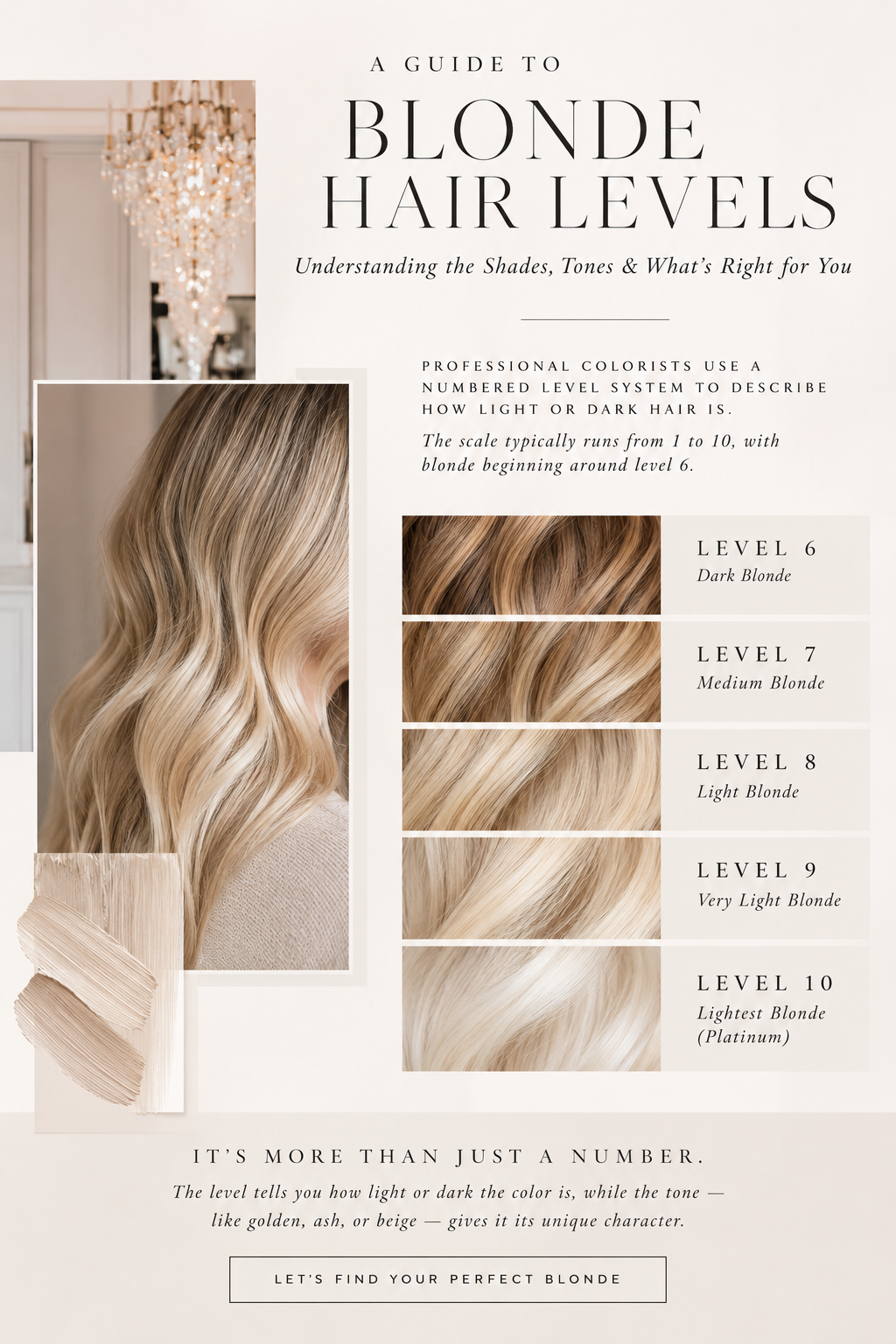
You've probably heard someone describe their hair as a "level eight blonde."
Or maybe your stylist has mentioned lifting your hair to a level nine before applying toner.
And you nodded politely while wondering what on earth those numbers meant.
Don't worry. We're going to explain.
Because understanding hair color levels can make your next salon consultation a whole lot more interesting.
First, What Is a Hair Color Level?
Professional colorists commonly use a numbered system to describe how light or dark hair is.
The standard scale runs from 1 to 10.
Level 1 represents the darkest hair, while level 10 represents the lightest blonde.
Blonde generally begins around level 6.
Here's a simplified breakdown:
Some professional color lines include additional levels or high-lift shades, but the 1–10 system is a useful starting point.
Wait. Isn't Platinum Blonde a Color?
Yes, but here's where things get interesting.
Hair color has both a level and a tone.
The level describes how light or dark it is.
The tone describes the color character: golden, ash, beige, pearl, copper, and so on.
That means two people can both have level-nine blonde hair and look completely different.
One might have a warm golden finish.
The other might have a cool, pearly blonde.
Same approximate lightness. Different appearance.
Why Does Your Natural Hair Color Matter?
Imagine two clients arrive at the salon with the same photograph of a pale blonde hairstyle.
One has naturally dark blonde hair.
The other has dark brown hair with previous color.
Their paths to achieving that inspiration may look very different.
Lightening hair involves working through underlying pigment, and previously colored hair may respond differently from untreated hair.
Your stylist considers your starting level, existing color, hair condition, and desired tone before creating a plan.
In some cases, reaching a very light blonde requires multiple appointments.
What Happens When Hair Turns Yellow or Orange?
During lightening, underlying warm pigments become visible.
Depending on your starting level and how far the hair is lifted, you may see red, orange, or yellow tones.
That's part of the reason professional colorists pay so much attention to formulation and toning.
A toner can help refine the final shade, but it cannot always compensate for hair that hasn't reached the necessary lightness.
Which Blonde Level Is Right for You?
That depends on more than your inspiration photo.
Consider your skin tone, natural hair color, maintenance preferences, and how much lightening your hair can comfortably tolerate.
A dimensional level-seven blonde can be every bit as beautiful as a pale level-ten blonde.
And sometimes a slightly deeper shade creates the richness, shine, and dimension you've been looking for.
The next time you sit in your stylist's chair, don't be afraid to ask what level your hair currently is and what level you're hoping to achieve.
Understanding the process makes the transformation even more exciting.